Russians and Americans Have Missed Each Other — President of AmCham in Russia
U.S. and Russian national flags wave on the wind before US Secretary of State Rex Tillerson arrival in Moscow’s Vnukovo airport, Russia, Tuesday, April 11, 2017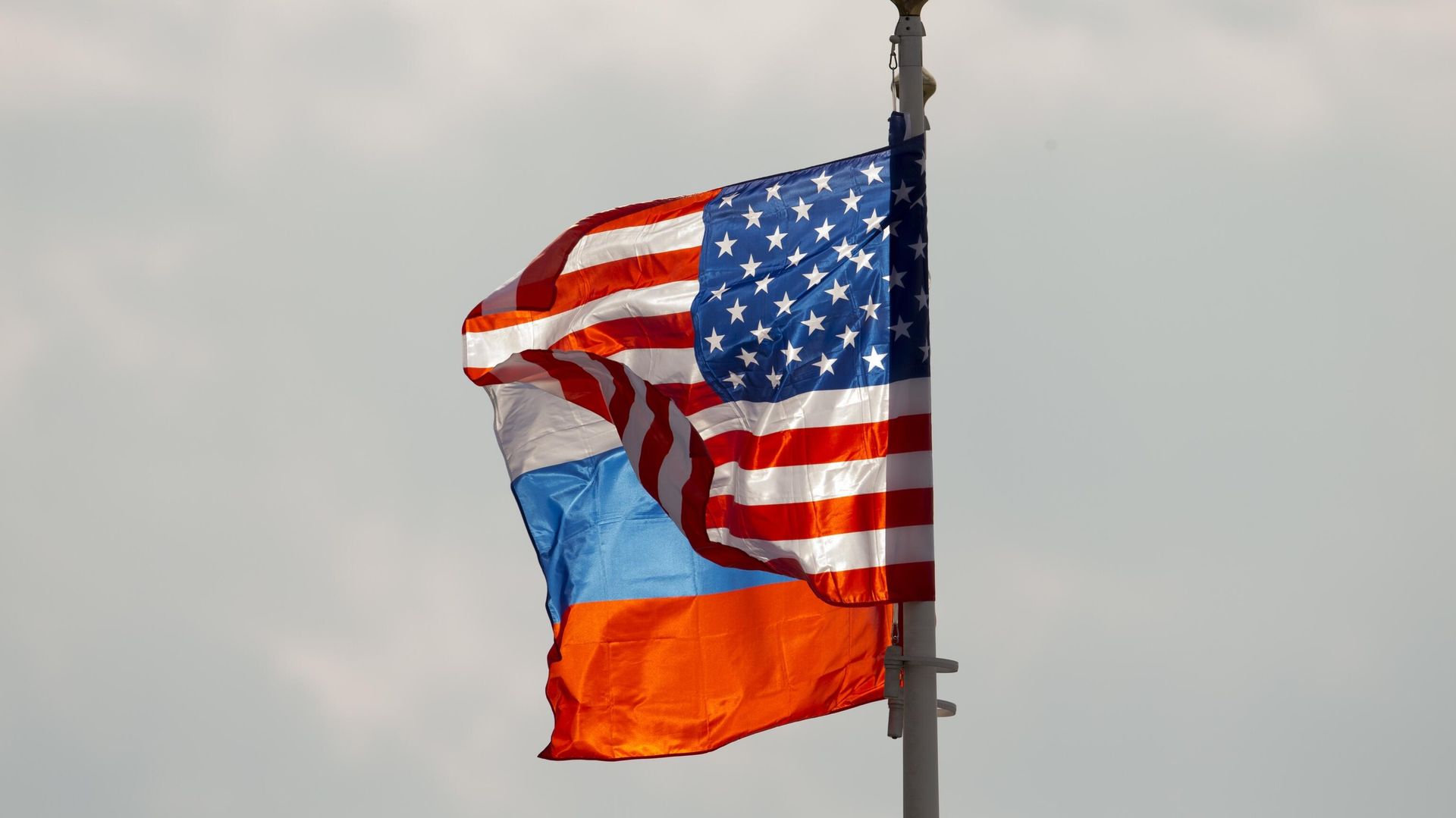
The Russian market has always been, and remains, attractive to Western companies — it is large, stable, and rapidly growing, Chief Executive Officer of the American Chamber of Commerce (AmCham) in Russia Robert Agee told Sputnik.He talked about how US companies are suffering from anti-Russian sanctions, why they cannot yet return to Russia, and who might accompany US President Donald Trump to Moscow in this interview.
– When your friends in the US ask, «So, how are you doing over there in Russia?» What do you tell them?
– I tell them that everything is fine, that American business in Russia continues to operate successfully, and that we do not feel any discrimination, even though Western companies are now classified as operating in unfriendly jurisdictions.Despite everything, we have very good relations with our colleagues, with Russia’s business community, and with the Russian government. We are constantly in touch, meet frequently, and discuss whatever needs to be addressed. When we have any issues, we take them to the relevant ministries, where we are listened to, given advice, and supported.
– Is it true that European businesses now harbor a certain envy toward you, since there are more American companies in Russia today than any other Western country?
– I wouldn’t put it that way. The fact is that only companies from a few Western countries completely, and I mean totally, left Russia after February 2022. Finnish and British firms, for example. Italian, French, and German companies, however, are still here. What is true is that the country was indeed left by major flagship Western companies such as Siemens, BMW, and Mercedes. But the backbone of German, as well as Italian and French, business in Russia has always been not these giants but small and medium-sized enterprises, the vast majority of which continue to operate in Russia. As for the US companies, only about 17% of them left. Each had its own reasons. Some did so under government pressure, others were prevented from operating by the imposed sanctions, and still others, while remaining, were forced to transfer their assets to Russian management.
– And no one left of their own free will?
– That’s a difficult question for me to answer. Right after the start of the special military operation, there was, frankly speaking, a certain confusion and even panic among Western businesses in Russia. Being in such an agitated state, perhaps some did make the decision to leave the country in the heat of the moment. At AmCham, we didn’t panic, by the way, on the contrary, we tried to convince everyone not to make hasty decisions and to keep a cool head.That said, of course, no one actually wanted to leave Russia. And that’s understandable. Russia’s market has always been, and remains, attractive to Western companies. It is large, stable, and fast-growing. Plus, it offers excellent prospects for establishing ties with neighboring countries in Central and Middle Asia. That’s why it has always been so important for American companies to localize production in Russia, to build plants and factories here [in Russia]. One of our companies, for example, currently has 12 of its own facilities spread across different regions of the Russian Federation.
– What are the American companies that stayed in Russia producing now?
– Mainly, they are producing FMCG — fast-moving consumer goods. That includes food products, pharmaceuticals, medical equipment, shampoos, and so on. I should add that US companies’ enterprises in the Russian Federation currently employ tens of thousands of Russian citizens. I know that one of these enterprises employs more than seven and a half thousand people.
– Which enterprise is that?
– Let’s leave it unnamed, shall we? You understand, most Western companies today prefer, for obvious reasons, to operate in Russia in a low-key manner and keep a low profile.AnalysisUS Companies Took $324 Billion Hit by Quitting Russia: Here’s Who Lost Most18 February 2025, 11:42 GMT
– And don’t the companies that can be named — Coca-Cola, McDonald’s, for example — want to return to Russia, or is that no longer possible?
– I wouldn’t say it’s impossible, but rather that it is very difficult today, even with all their desire to come back to Russia. And that desire, by the way, does exist among many American companies I know and whose executives I stay in touch with. They want to, but they can’t. Naturally, it all comes down to the numerous sanctions.AmCham, of course, is closely monitoring everything that is happening. We are preparing various documents that we send to the US, in which we emphasize the importance of lifting sanctions against Russia, particularly those that ban US investment in Russia, which were introduced under Biden. But the main condition for any progress in this direction is the end of the conflict between Russia and Ukraine, which we are all eagerly awaiting. To give you a concrete figure: due to anti-Russian sanctions, US business is truly suffering greatly — over the past four years alone, it has lost about $200 billion.
– You visit Washington quite often and know the situation from the inside. Is the White House monitoring what is happening to US business in Russia?
– Yes, our fate is not a matter of indifference to them. President Donald Trump has repeatedly spoken out in favor of restoring trade and economic ties between the US and Russia, emphasizing that this is the foundation of our relationship. That is why, I repeat, the White House’s top priority in US-Russia relations today is resolving the Russian-Ukrainian conflict.
– In what areas is the United States ready to cooperate with Russia?
– There are plenty of them, I couldn’t list all the areas at once. These include rare earth metals, space, the Arctic, the IT sector, and nuclear energy. Kirill Dmitriev, the head of the Russian Direct Investment Fund, recently correctly outlined the opportunities for Russian-US partnership in aviation as well. Just imagine how many American businesspeople will come with Donald Trump from the US to Moscow to sign various business agreements.
– And when is Trump planning to come to Moscow?
– I think as soon as the special military operation is over. After all, Vladimir Putin extended that invitation to the US president during their meeting in Alaska.
– Even during the Cold War, contacts between our countries never ceased in the fields of culture, the arts, sports, through «people’s diplomacy.» How important is that today?
– It is very important, and all these contacts must certainly be revived now. However, to be fair, it must be acknowledged that in the current difficult situation, any major breakthroughs on this path are unlikely to happen overnight, such as tours by famous theaters, concerts by popular artists, or large-scale exhibitions. I believe we need to start with the smallest steps. During the time Biden was in the White House, there were virtually no human-level contacts between our countries at all. He did everything in his power to drive us apart. I very much want to believe that those times are behind us. You know, I have a feeling that Russians and Americans have missed each other. The media in the US, of course, are doing everything they can to once again scare US residents with «treacherous Russia [stories],» but the American people, on the whole, do not believe these anti-Russian fabrications. Americans feel no antipathy toward Russians, just as Russians feel none toward Americans. I judge this largely from my own experience. I have been living in Russia for more than thirty years, and I have never once encountered a negative attitude toward myself, even at the everyday level, when I am out in public places. EconomyFour Years of Sanctions Flop: US Companies Bled $200 Billion in Hasty Russia Exodus 15 July, 07:03 GMT